
Balloons in Entertainment
Ballooning caught on quickly. Between 1783 and 1790, 76 flights were recorded in France alone. In 1784, a huge hot air balloon, built by the Montgolfiers carried a total of seven passengers to a height of three thousand feet over Lyon, France. Events such as these created world-wide interest in ballooning, and soon daring showmen began to stage flights for paying crowds. During this period, the hydrogen balloon replaced the hot air balloon as the aerostat of choice. It was safer, more reliable and had the potential to be used for long distance flights.
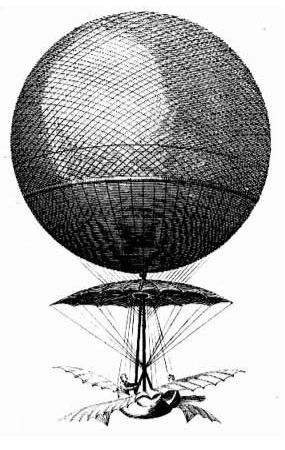
Jean-Pierre Blanchard became France’s number one aeronaut. After several years of barnstorming around Europe with his colorful fleet of balloons, Blanchard decided to attempt a crossing of the English Channel, the body of water separating England and France. On the afternoon of January 7, 1785, Blanchard and the American physician John Jeffries set off for Dover to make the attempt. Jeffries, who had personally financed the project, had every intention of going along on the trip. Blanchard had other ideas and contrived to take off without his backer, he even wore a lead belt so that the balloon would be too heavy for both men. At the last minute Jeffries jumped into the basket and the two ascended into the sky. By mid-channel, the balloon began descending into the water although the two aeronauts had jettisoned almost all their ballast, including the clothes they were wearing. Just as they were about to hit the water, Jeffries observed that the barometer was falling once again and that they were slowly ascending once more. The crossing ended safely in the forest at Guines. One interesting note on this flight was the first air mail letter which Jeffries carried with him for Benjamin Franklin’s grandson from his father. Jefferies hand delivered it five days later.
A few months later, during another attempt to fly across the English Channel, Pilâtre de Rozier perished. Unfortunately, he became the first victim of an air accident.
On June 24, 1784, a 13-year-old boy, Edward Warren, became the first American balloonist in a tethered ascent at Baltimore, Maryland.
It was also Blanchard who made the first free balloon flight in the United States in 1793 in Philadelphia. On hand to witness the ascent were George Washington and most of the Continental Congress. Blanchard’s balloon was a Charlière of brilliant blue and gold with a spangled blue gondola hanging from the netting. The aeronaut was also dressed in blue with a cocked hat sporting a large white feather. During his 15 minute flight, Blanchard performed some scientific experiments at the request of the new American government. He checked his pulse rate and took the weight of a stone he carried with him. Unfortunately for Blanchard, his flight was less than successful financially and he returned to France, vowing never to fly in America again.
Entrepreneurs throughout Europe took advantage of the ballooning craze, continually contriving new and different ways to outdo the competition and draw the biggest crowds. There were, perhaps, 300-400 aeronauts who made a living from ballooning during the late 1700s and throughout the 1800s. Of these, the best known were Blanchard, Garnerin, James Sadler, Charles Green, Mr. Wise, Mr. Coxwell and the Godard Brothers. In England, in 1821, Charles Green further popularized ballooning through the use of coal gas, a plentiful and relatively inexpensive source of lifting power. History records that Charles Green made as many as 546 flights to 31 years and died in 1870 at a very advanced age! His numerous flights made ballooning seem almost routine in these early years. In 1836, Green’s most famous flight carried him from London, across the English Channel, over France and Belgium to Germany, a distance of 772 kilometers (480 miles).
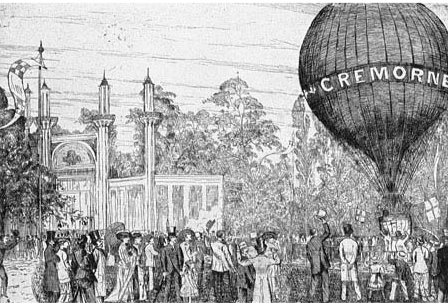
Copyright: The Royal Borough of Kensington and Chelsea Libraries.
Perhaps the most outrageous attractions were balloonists jumping from balloons with parachutes and flying with animals! One of the earliest of these daredevils was the flying Garnerin family. Garnerin contrived a design for a parachute while in a French prison and later tried it out with the help of his wife and niece. His wife became the first woman to jump from a balloon with a parachute. On July 31, 1850, James Green, a brother of the famed balloonist Charles Green, made the first balloon ascension on horseback! The horse was suspended under the balloon with its legs and head held still. The balloon was inflated and the horse and rider ascended above the crowd at England’s Vauxhall Gardens. Both landed safely. Greene was even said to have fed the horse some beans while in the air.
Many women also took to the skies as both balloonists and parachutists. Two of the most famous were Sophie Blanchard and Dolly Shepherd. Sophie was a part of her husband Jean Pierre’s act as he traveled throughout Europe. After he died she became the first woman to fly on her own and made 59 ascents in her balloon. Dolly Shepherd was just 17 when she took up ballooning and parachuting in the early 1900s. Dolly performed all over England, transporting her balloons from event to event by horse and wagon. Her act consisted of a balloon with a trapeze suspended below it. When the balloon rose into the air, Dolly would hold on to the trapeze until the balloon achieved sufficient altitude. Then, she would pull a ripcord, the balloon would collapse, and she would return gently to earth by parachute. Dolly died in 1983 at the age of 96.
Another attraction of the 1800s was the “smoke balloon”. These balloons were hot air balloons but did not have a heater or burner on board. A parachutist would attach himself or herself to the balloon. Helpers would hold the balloon over a fire until it was sufficiently heated, and, if it didn’t catch fire, they would let go and the chutist and balloon would ascend. Once the balloon reached its highest point and equilibrium was reached, the parachutist would let go and descend.