
Early Beginnings
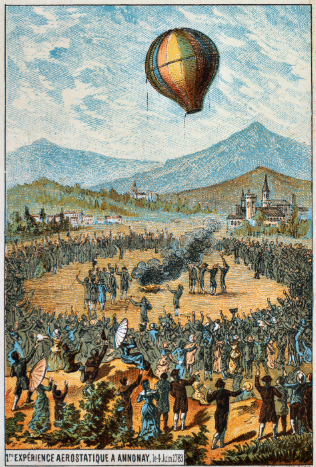
The history of ballooning began in Annonay, France, on June 4, 1783, when two brothers, Joseph and Etienne Montgolfier, launched an unmanned hot air balloon. The balloon rose to an altitude of 6,000 feet and traveled over a mile before landing. The two brothers, while not scientists, were highly educated and interested in science and flight. In 1782, while watching a fire in the fireplace, Joseph became interested in what caused the sparks and smoke to rise. He experimented with making paper balloons and later made a small bag of silk and lit a fire under the opening at the bottom, causing the bag to rise into the air. The brothers thought the burning created a gas which they called “Montgolfier gas” or “phlogiston”
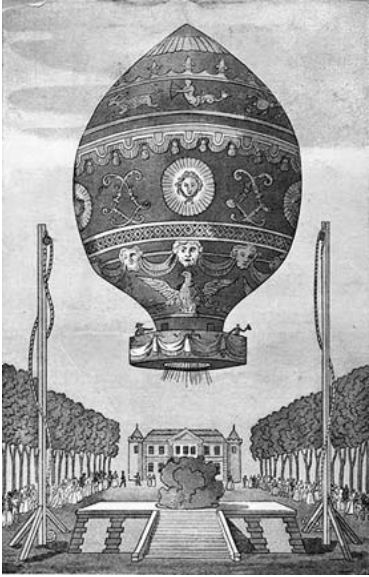
In September of the same year, the Montgolfier brothers demonstrated their wonderful craft for the King and Queen of France and the French Academy of Science. On September 19, 1783, the Aerostat Réveillon carried the world’s first airborne passengers - a sheep, a duck and a rooster. These animals were selected for specific reasons. The sheep was believed to have a reasonable approximation of human physiology. The duck, since it flew high, was expected to be unharmed by being lifted aloft. It was included as a control for effects created by the aircraft rather than the altitude. The rooster was included as a further control as it was a bird that did not fly at high altitudes. The safe ascent and descent of the animals proved that it was possible to breathe far above ground, thus paving the way for human flight. According to records kept at the time, the animals returned to earth uninjured and were later adopted by Marie Antoinette as her personal pets.
Although the Montgolfier brothers invented and tested the balloon, it was Pilâtre Rozier and the Marquis d’Arlandes who made the first flight on November 21, 1783. When King Louis XVI proposed to send a convict up in the first manned balloon, de Rozier objected strenuously. He is reported to have exclaimed “For the honor of France, the first aeronaut should be a man of science, not a murderer!” Permission was finally granted and de Rozier and the Montgolfier brothers built a giant aerostat 74 feet high and 48 feet in diameter. Around the bottom opening, 15 feet across, was a doughnut-shaped wicker catwalk 3 feet wide. At 1:54 pm on the day of the historic flight, de Rozier and D’Arlandes stepped onto the catwalk and cut the ropes rising into the air to an altitude of 3,000 feet. The flight lasted 25 minutes and covered a little more than 5 miles. The balloon could remain aloft only as long as an on-board fire continued to heat the trapped air. Wood and straw had to be carried for fuel and continually added to the fire. This was a difficult and dangerous process, as well as adding a great deal of weight to the balloon.
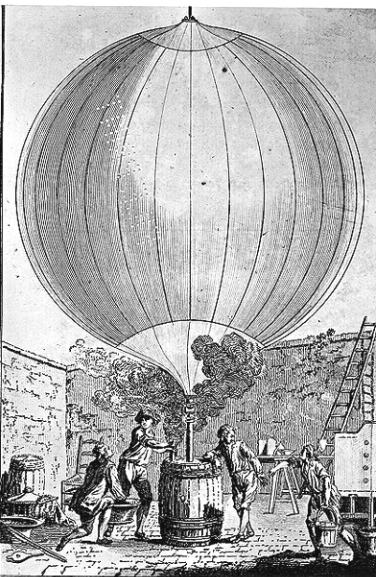
At the same time, another Frenchman, Professor Jacques A.C. Charles, was experimenting with hydrogen, the lightest known gas. Hydrogen had only been isolated as an element sixteen years before and scientists had some difficulty finding materials which would contain the gas. Charles used a small globe of rubberized silk for his balloon. He designed the bag to tie at the bottom to contain the gas, and to rise and fall using a combination of dropping ballast and releasing gas through a crude valve at the top. The design of the first gas balloon was so efficient that it is still in use today with only minor changes. After an initial unmanned test, Professor Charles, accompanied by Nicholas Robert, rose high into the air and drifted over Paris for two hours. The flight lasted for over two hours and covered more than 27 miles. This event was witnessed by Benjamin Franklin who immediately recognized the potential for uses of balloons in military operations. Because hydrogen is far more buoyant than hot air, the Charlière balloon offered many advantages. In addition, its heights could be controlled by a combination of dropping ballasts to rise and by releasing gas through a crude valve at the top of the bag to descend, methods still used today.
De Rozier took the concept one step further by designing and flying a combination gas and hot air balloon. The balloon was filled with hydrogen and a small fire was built under the balloon to continue to heat the air. Since hydrogen is highly flammable, the combination proved extremely dangerous and de Rozier and his companion were killed when the balloon exploded and burned. Ironically, with contemporary materials, this design has proven in modern times to be the most efficient for long distance and high altitude balloon flights. The combination gas and hot air balloons are still referred to as Rozières. The Brietling Orbiter and the Spirit of Freedom which made successful global flights, were Rozières.